Two Chairs, One Conversation: Why Pairing Up Beats the Big Group Chat

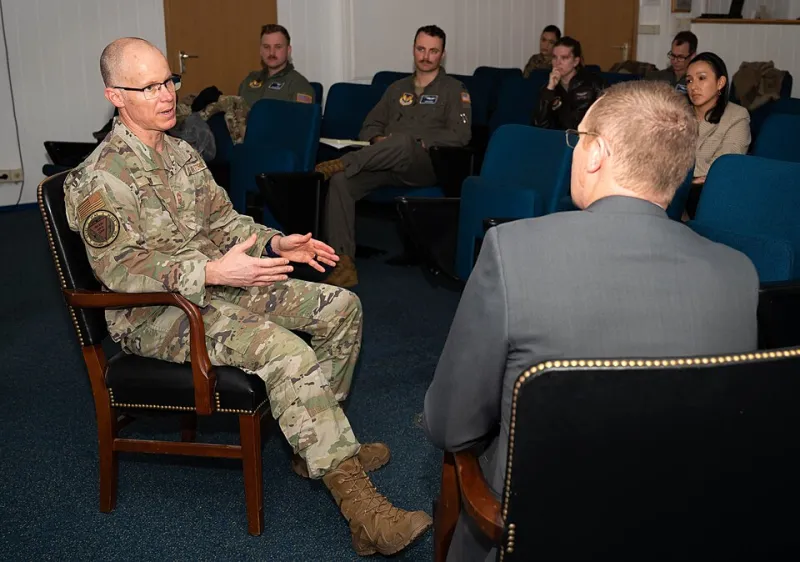
Photo: Pedro Ribeiro Simões from Lisboa, Portugal, CC BY 2.0, via Wikimedia Commons
There's a particular kind of silence that lands in a group chat when someone says something real. Forty-seven members, three thumbs-up, and then nothing. The message sits there while everyone quietly decides it's someone else's job to reply. Meanwhile, in a one-to-one conversation, that same sentence gets the response it deserves — even if the response is just that sounds rubbish, tell me more.
That's the argument I want to make here. For a lot of people, paired peer support does more of the heavy lifting than any group ever will. Not because groups are bad — they're brilliant for some things — but because the 'paired' in Paired Peers isn't a branding accident. It's a design choice, and it's one worth defending.
The maths of attention
In a group of eight, everyone gets roughly an eighth of the room. In a group of forty, you get a nod. Add in the usual dynamics — the confident talker, the person who arrived late and never quite caught up, the one who types and deletes — and the amount of actual support being exchanged gets thin pretty quickly.
One-to-one flips that. There's no queue for the floor, no need to perform your story in a way that entertains an audience, no scanning the room to work out whether you're taking up too much space. You get an hour where the whole point is that someone is listening to you, and then an hour where the whole point is that you're listening to them. That symmetry is the thing. It's not therapy, and it's not friendship in the usual sense — it's a deliberate, reciprocal exchange between two people who recognise something in each other.
What the group chat genuinely can't do
Group settings are wonderful for momentum. They're good for the person who needs to see that other people exist and are getting through Tuesday. They're good for announcements, signposting, and the low-effort sense of belonging that a busy thread can give you.
But they're not built for the specific, unhurried, slightly awkward work of saying the true thing out loud. Several people I've spoken to describe the same experience: they'll happily read a group chat for months, contribute nothing, and then open up completely the moment it's just them and one other person on a bench outside a community centre.
That's not shyness, necessarily. Sometimes it's sensory overload. Sometimes it's a chronic illness where energy is rationed and a two-hour group is simply off the table. Sometimes it's social anxiety, hearing loss, caring responsibilities, or the very reasonable suspicion that anything shared with thirty people will travel. One-to-one removes a whole layer of that friction.
The UK is already quietly doing this
If paired support sounds a bit niche, look at what's already running on your high street. NHS social prescribing link workers spend much of their week doing exactly this: sitting down with one person, working out what would actually help, and connecting them to something specific rather than pointing at a leaflet rack. It's a conversation-shaped intervention, not a leaflet-shaped one.
Then there are the small befriending schemes — the ones run out of church halls, housing associations, and local charities, often coordinated through networks like Befriending Networks. They match a volunteer with one person for a weekly phone call or a walk. No group, no rota of strangers, just a reliable human on a Tuesday. The reason those schemes persist, despite tiny budgets, is that they work for the people who would never turn up to a group.
Paired Peers exists in that same tradition. Shared experience, stronger together — but two at a time.
The unglamorous bit: boundaries
A two-person peer relationship is more intimate than a group, which is exactly why it needs a bit of structure. None of this is about being cold. It's about making sure the arrangement lasts longer than six weeks.
Agree a rhythm before you start. Weekly, fortnightly, a phone call on the first Sunday of the month. Put it in the calendar. Vague arrangements are the number one killer of paired support — both people end up waiting for the other to text.
Agree a length. Fifty minutes, an hour, whatever suits. Having an end time means nobody has to invent an excuse to leave, and it protects the person who will otherwise stay for three hours out of politeness.
Agree what's off-limits. Money, medical advice, and anything that turns you into someone's only lifeline. Signpost instead — Samaritans on 116 123, Shout on 85258, NHS 111, their GP, Citizens Advice. Knowing the numbers in advance means you're not scrambling mid-conversation.
Build in a no-rescue rule. You're a peer, not an emergency service. If your partner is in crisis, the plan is to help them reach proper help, not to become it. Say this out loud at the start; it's a relief to hear.
Keep it light on paperwork — but keep some. A shared note of what you've agreed, where you meet, and an emergency contact is plenty. If you're doing this through an organisation, they'll have their own version.
Review it. After six sessions, ask the blunt question: is this still useful to both of us? Sometimes the answer is no, and ending well is part of doing it properly.
The quiet case for two
Groups give you a crowd. Pairing gives you continuity — the same person, the same time, the same willingness to pick up where you left off. For anyone who has ever typed something honest into a chat and watched it disappear under a stream of memes, that reliability is worth a great deal.
Start with one person. See what happens.