The Off-Day Agreement: A Two-Person Plan for Weeks That Go Sideways

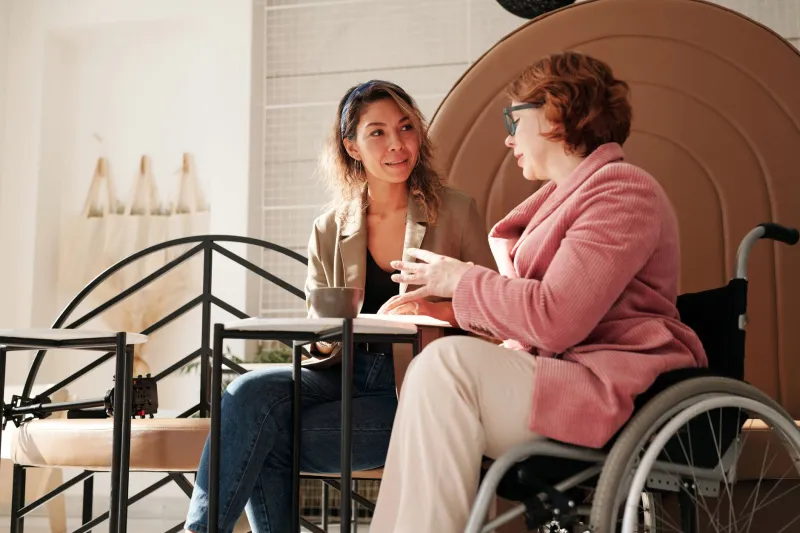
Photo: Pedro Ribeiro Simões from Lisboa, Portugal, CC BY 2.0, via Wikimedia Commons
Peer support is easy to picture on a good week. Two people, a cuppa, a decent chat, everyone leaves feeling a bit more human. Lovely. But that is not the week that tests a pairing. The week that tests it is the one where someone's energy drops through the floor, the NHS App refuses to load, a letter arrives with a date that clashes with everything, and neither person has the brain space to negotiate what happens next.
That is where an off-day agreement comes in. Not a contract. Not a rescue plan. Just a short, honest note written on a calm day, setting out how the two of you will handle the weeks when things go sideways. It is quiet insurance. And like most insurance, it is much easier to sort out before you need it.
Why write it on a good day
When you are in the middle of a bad week, every decision feels heavier than it should. Even a text saying 'no worries, shall we move it?' can feel like a mountain. Pre-agreeing the basics takes that weight off. It means neither person has to guess, apologise repeatedly or perform being fine when they are not.
There is also a fairness point here. Without a plan, the person who is struggling often ends up doing the emotional admin: explaining, rescheduling, reassuring. A simple agreement shares that load. It says: we already decided how this works, so neither of us has to invent it in the moment.
Keep it short enough to actually use
A good off-day agreement fits on one side of a page or in a phone note. If it needs a table of contents, it is too long. Aim for three sections: contact, cancellations and appointments. Add a line about saying no. Put both names and the date at the top. That is genuinely enough.
It helps to write it together, in person or on a call, rather than one person drafting a policy document and sending it over. The point is the conversation, not the paperwork. You are learning each other's defaults.
Contact levels: what does 'I'm quiet' actually mean?
Most misunderstandings in peer support are not dramatic. They are small gaps in translation. One person goes quiet because they are exhausted; the other reads it as a snub. One person sends three cheerful voice notes; the other feels pressure to match that energy.
So agree a few simple signals. You do not need a traffic-light system unless you enjoy that sort of thing. You just need words you both understand. For example:
- Green: normal contact. Texts, voice notes, a walk, whatever you usually do.
- Amber: low-battery mode. Short replies are fine. No need to explain. A thumbs-up counts as a full sentence.
- Red: radio silence. No reply expected. The other person sends one low-pressure message after a few days, with no follow-up required.
The important bit is the meaning you attach. 'No reply' does not mean 'I am annoyed with you'. It means 'I am not able to do messages today'. Write that down. It saves a lot of silent spiralling.
Cancellations without the guilt spiral
Cancelling is where many peer pairings get sticky. Someone pulls out, feels awful, over-explains, then avoids the next meet-up because they are embarrassed. The other person is left wondering whether they did something wrong. Nobody wins.
Agree a cancellation phrase in advance. Something plain like: 'I am off today, can we park it?' No medical essay required. Then agree what happens next. Maybe the person who cancelled suggests a rough window when they might be up for trying again. Maybe the other person sends a gentle invite after a week. Maybe the rule is simply: the pairing pauses, and either person can restart it without a big debrief.
Also agree that cancelling is not a debt. You do not owe a longer walk, a better chat or a bunch of biscuits to make up for it. The whole point of a bad-week pact is that bad weeks are allowed to happen without invoicing.
Hospital appointments and the boring bits
Hospital support is often imagined as a big dramatic thing. In reality it is usually admin, waiting and bad coffee. A letter arrives. The appointment is at 8.40am. The parking is a nightmare. The waiting room is too warm. You get seen late and then have to remember what was said.
Before any of that, ask a simple question: what kind of support is actually useful? Some people want company in the waiting room. Some want a lift. Some want a phone call the night before. Some want someone to help decode the letter, or to sit with them afterwards and write down what the consultant said. Some want to go alone and debrief later. None of these is wrong.
Write down who holds the appointment details, who is allowed to ring whom, and what 'help' means for each of you. If one of you is heading to a GP surgery or hospital department, agree whether a check-in text afterwards is welcome or whether silence is kinder. It is a small thing that prevents a lot of awkward hovering.
The right to say 'not today'
This is the clause that matters most. Both people need explicit permission to say 'not today' without guilt, and both need to know how to receive it. The receiver's line can be simple: 'Thanks for telling me. I am here when you are ready.' No fixing. No follow-up interrogation. No wounded silence.
It can feel oddly formal to agree this out loud, but it is liberating. It means the pairing does not run on obligation. It runs on consent and honesty, which are much more sustainable.
What not to put in it
An off-day agreement is not a crisis plan. It is not a promise to be available at 3am, and it is not a substitute for clinical care. If either of you is in crisis, the agreement is not the thing to reach for. Keep the boundaries clear. Peer support works best when both people know what it is and what it is not.
Avoid grand promises. 'I will always reply' is not a plan; it is a future guilt trip. 'I will reply within two days unless I have sent the amber signal' is a plan. Keep it human-sized.
Review it before the next bad week
Plans go stale. A pairing that worked around a hospital appointment may need a different arrangement six months later. Put a review date in the note, maybe once a season. Winter is a good time to revisit it, when the dark afternoons and the NHS waiting lists are doing their usual thing.
Then put it away. The best off-day agreement is the one you barely have to look at because you both remember the spirit of it: we planned for the rough weeks, so we do not have to perform in them.