When Someone Brings Backup: Peer Support with a Carer in the Room
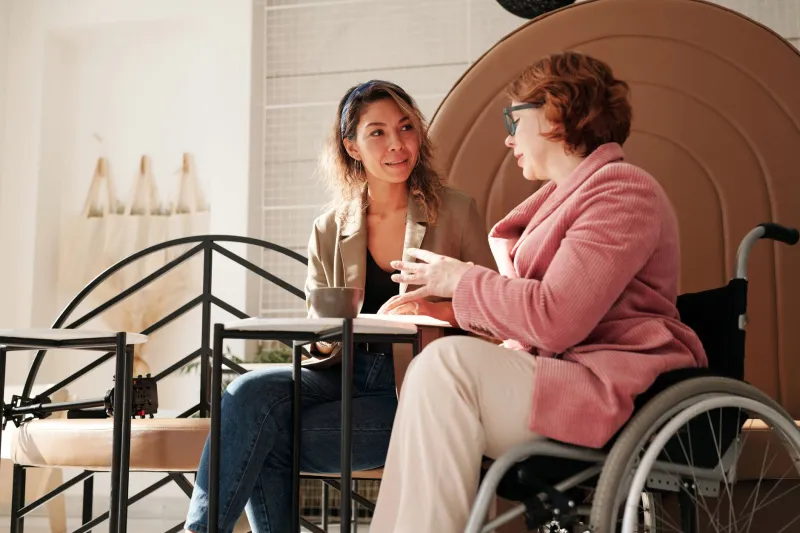
You have got your two-person rhythm. The chat is honest, the silences are comfortable, and nobody needs a big group to feel heard. Then one of you says they will need to bring someone: a paid carer, a parent, a support worker, an interpreter. The invitation was for two; now there are three. It can feel like the whole point — the equality, the privacy, the shared ground — is about to wobble.
It does not have to. It just needs a bit of thought before you meet, and a proper check-in afterwards. At Paired Peers, we are all for shared experience, stronger together — even when the room is a little fuller than you expected.
Sort the seating before the small talk
The physical layout does a lot of quiet work. If you can, choose a spot where the three of you can sit in a loose triangle rather than a row. That way the person you are paired with is not stuck between you and their carer, having to swivel like a spectator at Wimbledon. A round table in a cafe corner, two armchairs angled towards a sofa, a bench with a spare chair pulled up — anything that lets everyone see each other without craning.
If the person uses a wheelchair, do not assume the extra person needs to be the one to move the furniture. Ask. 'Where works best for you?' is a good sentence. It hands back control without making a fuss. If an interpreter is coming, they will often prefer to sit slightly to one side, so eye contact can flow between the two of you. Let them arrange themselves.
Ask the person, not the carer
This is the big one. When someone brings a carer, the temptation is to direct questions to the carer — especially if the carer is chatty. It is easy to slip into 'So, how has she been sleeping?' while the person in question is sitting right there. Try to keep your eyes and your questions on your peer. 'How have you been sleeping?' lands very differently.
That does not mean ignoring the carer. They are a person in the room, not a piece of equipment. Say hello, offer them a drink, include them in the small stuff. But when it comes to the peer conversation, your paired person is the one you are paired with. If they want the carer to answer, they will nod or signal. If they do not, give them the beat to speak.
Consent is not a one-off form
Before the meet-up, it is worth a quick, low-key message: 'Just so I know — how much would you like your carer to be part of the conversation? Happy to do whatever works.' That gives them a chance to say 'She will just be in the background' or 'I would like him to help me explain the medical bits' or 'Actually, I would rather we kept it to us and she waits in the cafe.'
If the carer is paid, they may have their own boundaries about what they can and cannot be party to. If it is a parent, they may be used to being the main point of contact and need a gentle nudge. Either way, check in with your peer, not just the person holding the diary. And check again during the meet-up if the conversation drifts somewhere sensitive. A simple 'Is this okay to talk about?' works for everyone in the room.
Steering without hijacking
Sometimes a carer will jump in — to clarify, to correct, to finish a sentence. It is rarely malicious. It can be habit, or anxiety, or just the rhythm of a long-term caring relationship. You do not need to police it. You can steer with small moves: turn your shoulders slightly towards your peer, ask an open question that invites them back in, or use a calm 'I would love to hear it in your words' if the carer is doing a lot of the talking.
If it keeps happening, you can name it kindly. 'I am really glad you are here — I just want to make sure your name gets the floor too.' That is not a telling-off. It is a reminder of the shared space. And if your peer seems happy for the carer to take the lead, let them. The point is not to enforce a rule; it is to keep the connection alive.
The afterwards bit
Every meet-up ends, everyone says goodbye, and you might feel a bit wobbly. Did that still count as peer support? Did the carer leave thinking you were useless? Did your peer feel heard?
Send a short message the next day. Not an essay. 'Good to see you yesterday. Hope the rest of the week is kind. Same time next month?' If you want to check something specific, keep it light: 'I was not sure if I got the balance right with your carer there — tell me if you would rather we did it differently next time.' That gives them permission to be honest without turning it into a big debrief.
And if you are the one who brought the carer, you can do the same. A quick 'Thanks for rolling with it' goes a long way. The paired dynamic is not lost just because there are three chairs. It is kept by small acts of attention.
Venues that actually work
UK-specific practicalities matter. If you are booking a cafe or community room, check step-free access, the width of the doorway, and whether the accessible loo is actually open and not locked and used as a storage cupboard. Changing Places toilets are still rare, so if that is needed, ring ahead. Libraries and community centres often have quieter rooms and hearing loops; some will let you book a corner for free. Chain cafes vary wildly — one branch has a ramp, another has a step and a hopeful attitude.
If travel is a barrier, think about community transport, Dial-a-Ride, or meeting somewhere on a direct bus route. A venue that is easy for your peer but impossible for the carer is not much use. And if the carer is an interpreter, ask whether they need a break every hour or so. Interpreting is hard work; a pause is not an inconvenience, it is part of the setup.
Keep the pair at the centre
Peer support is not about excluding anyone. It is about making sure the person you are paired with still has room to be themselves in the conversation. A carer, a parent, or an interpreter can be part of that — or they can accidentally become the main character. The difference is usually a bit of preparation, a few well-placed questions, and a willingness to check in afterwards.
You do not need a script. You just need to remember that the third chair is still a chair, and the pair is still the point. Shared experience, stronger together — even when the room is a little fuller than you expected.